



Money is a funny thing in real estate. Agents will spend thousands on marketing but hesitate over a $50 monthly software fee. It makes sense, though. Every subscription adds up. The world has moved to a subscription-everything model and everyone is just tired of another monthly charge hitting their account.
But there are the real costs nobody talks about. A deal that died because a follow-up email never went out. The referral that lost because nobody checked in at the right time. The buyer who picks another agent because responses came too slowly.
Free CRMs exist. They’re legitimate tools, not just trial versions pretending to be helpful. But when you pay value, you get value. Paid CRMs promise automation, better features, and support when things break. Both can work. Both can also waste your time if they’re the wrong fit.
The decision isn’t really about free versus paid. It’s about what your business actually needs right now.
This guide walks through what each option really delivers, where they fall short, and how to pick the one that actually helps close more deals instead of just adding another login to remember.
Free Real Estate CRM vs Paid Options Explained Simply
Free doesn’t always mean completely free. Some CRMs offer a forever-free plan and you get basic features. Others give a free trial that expires after two weeks or a month. The duration of free plans and limitations vary. A few limit the number of contacts or deals you can manage before charging kicks in.
Paid CRMs work on subscriptions mostly. Monthly fees usually range from $20 to $150 per user, depending on features. Annual plans often come with certain discounts. Enterprise options for agents and teams can run into thousands, but those include dedicated support, advanced reporting, and more bandwidth. The pricing mentioned here is only tentative. But if you’re considering NOVACRM, you can always get in touch with our sales team and request pricing.
Here’s what the difference actually looks like in daily use:
| Aspect | Free CRM | Paid CRM |
| Contact storage | Limited (often 500 – 1,000) | Unlimited or very high limits |
| Automation | Basic or none | Email sequences, task triggers, follow-up chains |
| Integrations | Few (email, maybe calendar) | MLS, Calendars, Social Media platforms, marketing tools |
| Support | Help docs, community forums | Live chat, phone support, and onboarding |
| Customization | Minimal | Custom fields, pipelines, reports |
The real question isn’t which costs less upfront. It’s which one handles the work that’s actually slowing business down. Free tools work fine when lead volume stays manageable and manual follow-up doesn’t kill conversion rates. Paid software makes more sense when time becomes more valuable than the monthly fee. When comparing free real estate CRM vs paid options, consider what deals get lost without proper automation. There are many other aspects you can clearly see in the table above.
Why Free CRMs Seem Like the Best Option at First
New agents don’t know how much money they’ll make yet. When commission checks change a lot from month to month, spending $75 a month on software seems like a big risk. Free CRMs take that financial stress away. Some of them let agents keep track of contacts. Some free CRMs allow them to set reminders without raising overhead costs.
Budget worries aren’t just for new agents. Solo practitioners who work part-time or in markets that aren’t as busy keep an eye on every cost. A free tool that takes care of the basics, like managing contacts, writing notes, and making task lists, covers most of what you need at first. It beats having information spread out over phones, emails, and random notebooks.
Testing systems is also important. Real estate agents don’t know a lot about software. Before spending money, they need to see how a CRM fits into their daily lives. With the free versions, you can try out different interfaces, test workflows, and see which features people actually use. It’s better to pay for a year up front and then find out that the system doesn’t work the way your business does.
Free feels safe. It takes away the worry that comes with paid commitments that you might not like it.
When Free CRMs Make Sense Early on
New licensees with fewer than ten active leads don’t need advanced automation. A free CRM can store contacts and keep track of basic follow-ups just fine. Agents who are trying out different types of properties, like rentals, commercial, and luxury, can benefit from testing systems without having to pay for them.
Part-time agents who close three to five deals a year won’t use half of the features that paid versions have. They don’t get too many leads, so they don’t have to do too much manual work. Free tools also work for agents who only want to get referrals and don’t want to grow their client base. In these cases, relationships are more important than automating the pipeline.
The Real Trade-Off of Free CRM Tools
Free CRMs don’t cost money up front, but they do cost time. Realtors can see the limitations of free CRM for realtors every day, not just when buttons are missing. When business picks up, contacts hit their limits. There are no integrations, so data has to be entered twice.
At first, these aren’t dealbreakers. When an agent starts closing more deals and can’t scale systems to keep up, that’s when they become problems.
- Contact limits hit quickly: Most free plans only let you store 500 to 1,000 contacts. That sounds like a lot, but when you have to keep track of past clients and active leads, it’s not enough. You shouldn’t delete old contacts to make room in a database.
- A lot of manual work builds up: Without automation, each follow-up email has to be typed out by hand. There are no such things as drip campaigns. You have to enter birthday reminders into your calendar by hand.
- No real connections: Free tools don’t usually connect to MLS feeds, software for managing transactions, or marketing platforms. Agents copy and paste data from one system to another. Mistakes happen more often. Nothing talks to anything else, so response time suffers.
- Help goes away when it’s needed: People who don’t pay get help articles and forums. Paid customers can talk to someone on the phone or through live chat.
Eventually, agents who are growing look for the best CRM for new real estate agents that will grow with their business. The change happens when the time spent on daily workarounds costs more than the cost of a subscription. Once free starts costing deals, it stops being free. Agents realize they’ve outgrown the tool at that point, not because it’s bad, but because their business has scaled.
Lead Organization in Free vs Paid CRM Systems
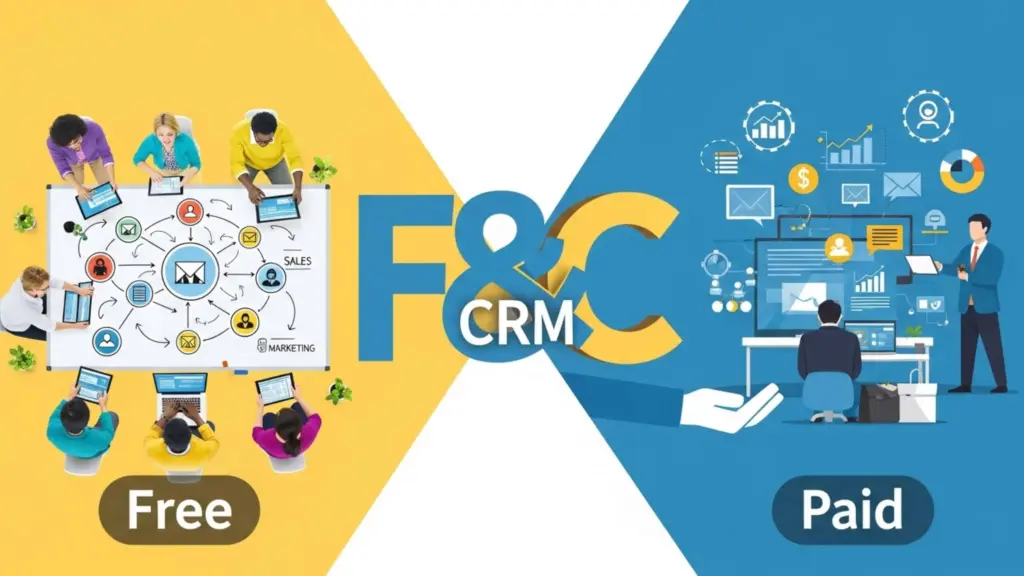
Lead chaos is worse for conversions than bad marketing. You can store names and phone numbers in free CRMs, but they don’t sort leads by stage, urgency, or temperature. There is one big list of everything. Agents go through dozens of contacts to remember who needs a call back today and who is just looking for next year.
| Organization Feature | Free CRM | Paid CRM |
| Pipeline stages | Basic or none | Custom stages for each deal type |
| Lead scoring | Not available | Automatic based on engagement |
| Response tracking | Manual notes | Time-stamped and automated alerts |
| Social media management | Limited account slots | Multiple accounts and platforms can be integrated. |
Paid systems make visual pipelines that automatically move leads through different stages. A new inquiry reaches “first contact.” It goes from “showing” to “active buyer” after that. When an offer is made, it changes to “under contract.” Agents can see exactly where each deal stands without having to open each record. The stages and their can be customized they are not same in all CRMs.
Response time gets better because hot leads are marked right away. Agents can remember everything with free tools, which means that something will be forgotten. Not just storing information somewhere retrievable, but systems that bring up the right contact at the right time are what make real estate lead management work.
Email Follow-Ups and Taking Care of Clients for a Long Time
Most people who are buying don’t make offers the first week they start looking. They look into neighborhoods, compare prices, wait for the right property, and take their time making one of the most important financial decisions of their lives. That timeline goes on for weeks or months. The person who answers the first question isn’t always the one who closes the deal. It’s whoever stayed in sight until the decision was made.
Free CRMs can’t keep that presence up on their own. An agent needs to keep track of where each lead is in their timeline by hand, remember to send them market updates and set up check-ins that feel helpful instead of pushy. This system falls apart when business picks up. The agent only pays attention to active deals and ignores everyone else.
Paid CRMs see nurture as part of the infrastructure, not a job. A pre-made email sequence runs in the background. Every month, tire-kickers get comparative market analyses. Every three months, move-up buyers get renovation ideas. The CRM keeps track of everything. The agent stays on your mind without you having to do anything.
Agents decide when to upgrade their real estate CRM after losing a deal they should have won. The lead was warm six months ago, then went quiet, and then came back with a new agent. That pattern happens often enough that it costs less to upgrade than to keep losing conversions to people who just remembered to follow up.
How Automation Sets Free Tools Apart from Paid CRMs
Automation isn’t about being lazy. It’s about being reliable. Eventually, agents who do all the follow-ups by hand forget about someone. A hot lead from Tuesday gets lost in the chaos of Wednesday. The real power comes out in multi-touch campaigns when real estate marketing automation takes care of things that agents can’t do by hand. That buyer has three other agents calling them back faster by Friday. The homebuyer receives personalized emails automatically and agents have to set up drip campaigns only once.
Free CRMs remind the agent, but paid CRMs do things automatically. A reminder to email someone still means that the agent has to write and send the email, which takes time and mental energy. Automation writes the email, sends it at the best time and keeps track of whether it was opened without any help from an agent.
Paid real estate CRMs do more than just save time
They follow their strategy without having to make decisions every day.
| Type of Automation | Free CRM | Paid CRM |
| Task reminders | Manual alerts | Auto-assigned based on lead stage |
| Email sequences | Not available | Drip campaigns with triggers |
| Lead assignment | Manual sorting | Round-robin or rule-based routing |
| Follow-up timing | Agent decides each time | Pre-set intervals and behavior-triggered |
A new lead gets an introduction email right away, a market report three days later, and listing alerts based on their search criteria without anyone having to do anything. The sequence changes if they open emails but don’t reply. For email marketing for real estate to work, messages need to go out regularly and be timed to when buyers are most likely to respond, not just when an agent remembers to hit send. A showing invitation automatically goes out when they click on a property link.
Free tools are what make agents work. Paid systems put agents in charge. One way works better as the business grows. The other one falls apart under pressure and becomes another task that needs to be done during the busiest weeks of the year.
When Free CRMs Start Limiting Growth
Problems come up when you are successful. An agent goes from doing five deals a year to fifteen. There are more and more ways to get leads. For example, past clients tell their friends about you, open houses get people interested, and online ads bring in buyers from three counties. Last year, everything worked perfectly, but now it feels slow and clunky.
The tool didn’t stop working. The business got too big for it. If you want to keep track of thirty active conversations in a free system, you’ll have to scroll through lists, update stages by hand, and hope you don’t miss anything important. The limitations of free CRM for realtors show up as missed callbacks. They often forget to follow up and let leads go cold because no one knew they needed help.
Integrations have the highest opportunity cost. A paid CRM connects to MLS feeds, automatically pulls listing data, and works with tools like an IDX website that send buyer leads straight to pipelines. You have to enter all the data by hand in free systems. An agent would spend two hours a week copying information between platforms. That’s eight hours a month that could have been spent on showings, listings, or calls with clients.
The real question isn’t if a free CRM works. It’s about whether it works well enough that growth isn’t happening somewhere else, with an agent whose systems can keep up with their goals.
Clear Signs It’s Time to Update Your CRM
Systems don’t announce when they’ve stopped serving the business. They just create more work. An agent spends lunch breaks catching up on data entry. Evenings go to sorting through contacts trying to remember who needed a callback. On weekends, you clean up duplicate records or figure out which leads went cold.
These tasks aren’t just annoying. They’re signs that the infrastructure can’t handle the current amount of traffic. When to upgrade real estate CRM is usually when something important goes wrong, like a hot buyer who stopped responding or a listing appointment that never got scheduled.
| Trigger Signal | What It Looks Like | What It Costs |
| Lead volume spike | Scrolling through 50+ contacts daily | Slow response times, lost conversions |
| Missed follow-ups | Forgetting callbacks or scheduled emails | Deals going to faster competitors |
| Team expansion | Multiple agents accessing same database | Confusion over who owns which lead |
| Manual data entry | Copying info between tools regularly | 5–10 hours weekly on admin work |
| No pipeline visibility | Can’t see deal stages at a glance | Deals stalling without anyone noticing |
The conversation about upgrading starts when the daily problems cost more than the subscription fee. An agent who loses one deal every three months because of system problems is losing more than they would by paying a small subscription for better infrastructure. Teams that split leads by hand waste hours that a smart real estate CRM system can do in no time.
Instead of having to switch platforms later, scalable systems like NOVACRM grow with the business. The goal isn’t to find the best software. It’s finding software that stops being the reason growth feels harder than it should.