


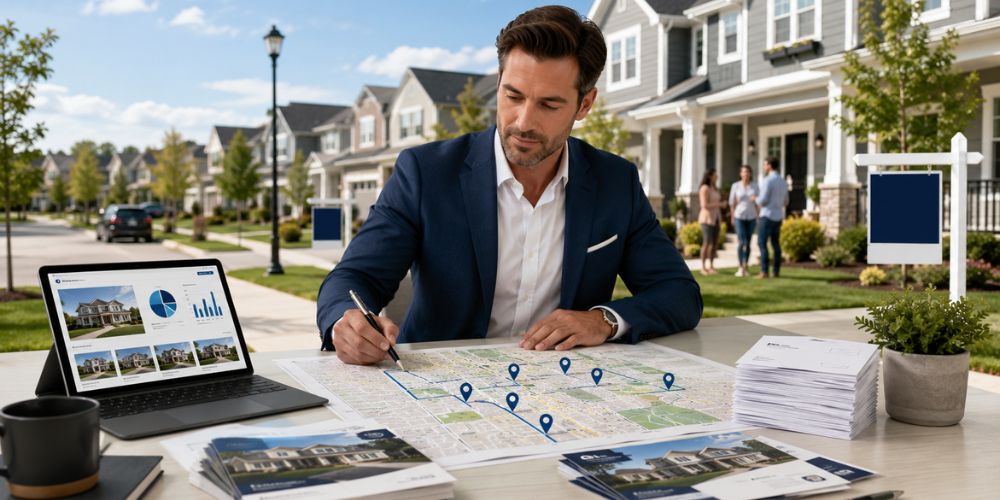
Real estate farming ideas are a way to get consistent listing appointments. You have to do it on purpose. Many agents just send out postcards to people in certain areas, and then they do not get any phone calls.
Some agents use a real estate CRM with text messages to follow up with people who might want to sell their homes. This system helps them keep talking to homeowners all the time.
The difference between agents who’re really successful in a neighborhood and those who are not is that the good agents are always there in person, and they are smart. It is how they follow up with people online, and they really help people. Real estate farming is what makes this happen for them. They use real estate farming to get.
What are the Strategic & High-Impact Farming Ideas for Realtors
1. Monthly Market Postcards with Video Integration
Send out two-sided postcards featuring recently sold and under-contract properties. Include a QR code that links to a quick 30–60-second video of yourself explaining the data. Video builds familiarity and trust in a way that a static piece of mail simply cannot.
2. Door-Knocking with True Substance
Skip the awkward sales pitch. Instead, spend two minutes sharing genuine, localized market activity with a neighbor and leave behind a useful one-sheet containing a practical seller preparation checklist.
3. Equity-Targeted Snapshot Mailers
Stop sending generic “thinking of selling?” cards. Use public records to pinpoint homeowners who have lived in their houses for over ten years, and send them a personalized equity snapshot showing how much their property value has grown.
With the right real estate lead management software, you can organize contacts, automate follow-ups, and convert more prospects into long-term clients.
4. The Neighborhood Open House Series:
Turn standard open houses into hyper-local community mixers. Hosting a themed event, like a “Sunday Sunset Open House,” creates a relaxed, social atmosphere where curious neighbors feel welcome to stop by, chat, and eventually ask for property valuations.
5. Seller Education Workshops
Partner with a neighborhood café to host a free, 45-minute morning workshop on how to maximize a home’s sale price. Homeowners who invest a Saturday morning in learning about staging and timing from you are highly likely to list with you when they are ready to sell.
Choosing from the best real estate CRMs can improve lead management, automate follow-ups, and increase conversions. Explore a solution designed to help agents grow their business faster.
6. Localized Business Partnerships
Team up with nearby moving companies, landscapers, or hardware stores to create an exclusive “Welcome to the Neighborhood” package for recent buyers, positioning yourself as the ultimate connected local expert.
7. Visible Community Sponsorships
Back local causes that neighbors care about, such as youth sports teams, school PTAs, or community garden projects, ensuring your name is associated with giving back to the area.
8. Private “Pocket Listing” Networks
Cultivate a private list of local homeowners who aren’t ready to hit the public market but would sell quietly if the right buyer came along. This gives you exclusive inventory to discuss with prospects and establishes you as the neighborhood insider.
9. Systematic Expired Listing Outreach
Develop a dedicated, empathetic approach for homes within your farm that failed to sell with other agents. Don’t repeat the same aggressive scripts they’ve already heard; instead, present a completely revamped marketing blueprint and concrete proof of your local track record.
Many missed opportunities come from listings that never sold. Discover how to reconnect with motivated sellers and win more business with this complete guide to expired real estate leads.
10. Hyper-Local Charity Drives
Organize a neighborhood-wide food, coat, or toy drive. Dropping off donation bags and picking them up directly from neighbors’ porches is a powerful, heartwarming way to build goodwill and connect face-to-face.
Learn proven neighborhood-focused strategies in this guide to hyperlocal real estate marketing and build a stronger presence in your target market.
Modern Digital & Automation Farming Tactics
11. Permission-Based Text Alerts
Build an opt-in list of neighbors who want immediate text alerts about new listings or sudden price changes in their subdivision. Texting boasts an open rate of over 90%, offering a highly direct, spam-free line of communication.
12. Hyperlocal SEO Landing Pages
Build dedicated web pages specifically optimized for individual subdivisions or neighborhoods. Fill these pages with real-time statistics, school updates, and clear calls-to-action so you rank at the top of Google when locals search for their community.
13. Active Nextdoor & Facebook Group Engagement
Join local digital community spaces, but leave the advertising behind. Treat these platforms as a community service by answering real estate questions, sharing construction or zoning updates, and highlighting local events.
Not sure what to say after meeting a prospect? This guide to real estate follow-up emails shares simple strategies to stay connected and move leads closer to conversion.
14. Street-by-Street Video Walkthroughs
Produce high-quality, engaging video tours of your farm area. Highlight the best parks, favorite local coffee shops, and architectural styles, then share these across your social channels to prove your native knowledge of the area.
15. Quarterly Digital Market Reports
Send a highly detailed, beautifully designed email newsletter every three months that breaks down average days on market, inventory shifts, and buyer demand specifically for your farm zone.
16. Targeted Social Media Lookalike Ads
Use your CRM to run localized Facebook and Instagram ads targeted specifically at the zip codes or demographics within your farm, ensuring your digital presence mirrors your physical mailers.
Social media can attract new prospects every day. Learn how social media lead generation with CRM helps you capture, organize, and nurture leads more effectively.
17. Client Review Spotlights
Whenever you close a deal in or near your farm area, share a digital case study or video testimonial from that specific client, allowing neighboring homeowners to see real-world proof of your success.
18. Automated Home Valuation Nurture Sequences
Drive digital traffic to a landing page where homeowners can check their estimated home value. Once they opt in, use your CRM to automatically send them subtle, high-value updates on local real estate trends over time.
19. AI-Enhanced Outreach Assistance
Integrate conversational AI tools within your CRM systems to follow up instantly with online inquiries or property valuation requests, ensuring no interested neighbor is left waiting. AI cold calling for real estate helps agents automate outreach, qualify prospects, and focus on high-value conversations.
20. Interactive Neighborhood Maps
Create an online, interactive map of your farm area featuring recent sales data, historical zoning facts, and neighborhood amenities that locals can easily browse on your website.
Designing Your 90-Day Blueprint: Real Estate Farming Postcard Ideas
Success in real estate farming doesn’t happen overnight; it requires a systematic approach to build momentum.
| Phase | Month | Key Activities | Primary Goal |
| Foundation | Month 1 | • Choose a 500-home farm• Pull equity and tenure data• Start a postcard series• Build a prospect database | Establish a consistent outreach strategy |
| Omni-Presence | Month 2 | • Launch a neighborhood video campaign• Deploy targeted digital ads• Track QR code responses• Track text message responses | Increase local brand visibility |
| Connection | Month 3 | • Host a seller seminar• Deliver a quarterly market report• Monitor engagement and lead activity• Measure and optimize ROI | Strengthen client relationships and refine strategy |
Great posts do more than collect likes. Check out these effective Facebook marketing ideas for real estate agents to increase engagement and grow your audience.
Month 1: Selection and Research
Weeks 1 & 2: Focus entirely on data. Select a manageable farm area. It will ideally be around 500 homes or one square mile. Pull ownership records to identify long-term owners with significant equity, and analyze the neighborhood’s turnover rate.
Weeks 3 & 4: Set your foundation. Launch your introductory postcard series and configure your CRM’s automated text sequences for anyone who opts into your digital channels.
Month 2: Expanding Your Footprint
Weeks 5 & 6: Introduce video content. Film a walking tour or a quick market recap of the neighborhood and share it across your social media channels.
Weeks 7 & 8: Layer in your digital ads to match your physical mailings. It ensures that when a homeowner sees your card on their counter, they also see your helpful real estate tips on their social feeds.
Month 3: Deepening Community Ties
Weeks 9 & 10: Host your first in-person community event, such as a seller seminar or a themed open house, to transition your digital and mail relationships into face-to-face handshakes.
Weeks 11 & 12: Deliver your first comprehensive quarterly market report. Review your tracking data (QR code scans, text replies, phone calls), see which tactics are driving the most listing appointments, and double down on what works.
Direct Mail vs. Digital: Finding the Right Spot
| Feature | Direct Mail (Postcards, Flyers) | Digital Channels (SMS, Social, SEO) |
| Primary Strength | Tangible, high-impact, visible on kitchen counters. | Instant engagement, lower cost, easy to track. |
| Best Audience | Excellent for established, long-term homeowners. | Highly effective for younger, tech-savvy owners. |
| Response Speed | Slower, compounding build-up over months. | Real-time tracking and immediate conversation. |
| The Ideal Mix | Use physical mail to build trust and authority. | Use digital tools to capture responses and automate follow-up. |
FAQ About Best Real Estate Farming Ideas
Q: How often should I farm a neighborhood?
A: Minimum three meaningful touches per month; increase cadence if ROI is positive.
Q: Which neighborhoods to farm first?
A: Choose small, walkable areas with rising comps, moderate inventory, and many long-term owners.
Q: How long before farming produces listings?
A: Most agents start seeing meaningful results within 3–12 months. However, regular follow-ups and smart tracking often speed up the process.
Conclusion
Real estate farming helps you build trust and stay visible in your local market. Consistent outreach keeps you connected with homeowners.
Start with postcards, text messages, and neighborhood events. Share useful information that homeowners value.
Use a real estate CRM to manage contacts and schedule follow-ups. Track listing appointments, leads, and new clients.
Review your results regularly and measure what works best. Then, improve your strategy based on real data.
Over time, consistent real estate farming ideas can grow your brand and increase referrals. It can also help you win more listings and clients.