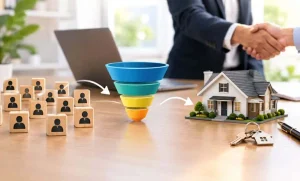



Quick Answer: A real estate lead capture landing page is a single-purpose page that trades something a buyer or seller wants, like listings, a home value, or an open house RSVP, for their contact details. The best ones load fast on mobile, ask for little, match the ad that sent the visitor, and push every lead into a CRM for instant follow-up.
Most agents I work with don’t have a traffic problem. They have a page problem. Ad money goes into Facebook and Google, the clicks land on a homepage or a generic “contact me” form, and the cost per lead keeps climbing.
Real estate lead capture landing pages solve the first half of that. Each one gives a visitor one clear reason to share their details and nothing else to click. The second half starts after the form is submitted. A page can only collect a name. What turns that name into an appointment is the system behind it, which is why agents pair their pages with real estate lead management software that sends the promised report the moment a lead registers, starts follow-up automatically and keeps every inquiry organized.
Below, I’ll cover the page types worth building, what a high-converting layout looks like, the IDX search features that pull in registrations, and how to tell whether your pages work once they go live.
What Is a Real Estate Lead Capture Page?
Definition: It’s a standalone page built around one offer and one form. The visitor shares a name, email or phone number and gets something they already want in return: a home value estimate, access to listings, an open house spot or a buyer guide.
Your homepage introduces you and invites people to explore. A landing page removes the menu, blog links and social icons, so the only action left is the one you want.
That focus also makes results easy to measure. One page, one offer and one traffic source tell you exactly which ad or flyer produced which lead.
5 Landing Page Types Worth Building
Not every real estate agent landing page should look the same. The offer depends on who you want to reach and how close they are to a decision.
| Page type | Who it attracts | Offer | Lead readiness |
| Home valuation | Homeowners thinking about selling | Free home value or CMA | Medium to high |
| Listing search | Active buyers | Saved searches, new listing alerts | High, but quick to bounce |
| Open house | Local buyers and curious neighbours | RSVP, digital sign-in, feature sheet | High |
| Single property or pre-construction | Buyers interested in one home or project | Price list, floor plans, VIP access | High for that project |
| Free guide | Early-stage buyers and sellers | First-time buyer guide, relocation guide, market report | Low to medium |
Two notes from running these:
- Home valuation pages bring in seller leads, but an automated estimate alone rarely wins the listing. Promise a prepared CMA as the next step so the lead has a reason to talk to you.
- Pre-construction pages work well in markets with active condo and townhome launches. Buyers register early for floor plans and pricing, so the page must deliver those files the moment the form is submitted.
Open House Landing Page: Replace the Paper Sign-In Sheet
This page does two jobs. Before the event, it collects RSVPs from ad clicks and social posts. On the day, a QR code at the door replaces the clipboard.
Paper sheets bring the same problems every weekend: unreadable handwriting, fake emails and a stack of names nobody enters into the CRM until Tuesday. A digital sign-in fixes that:
- Visitors type their own details, so the data is cleaner
- Each sign-in lands in your CRM tagged with the property address
- The feature sheet can go out by text or email before they reach their car
- You can ask one qualifying question, like “Are you working with an agent?”
What High Converting Real Estate Landing Pages Have in Common
Benchmarks help here. Unbounce’s Conversion Benchmark Report found that real estate landing pages convert at a median of 2.2%, while the top quarter convert at 20.2%. Most of that gap comes from design and offer, not traffic.
The best-performing pages I’ve seen share these traits:
1. Message match. The headline repeats the ad’s promise. If the ad said “See every 3-bedroom under $900K in Oakville,” the page says the same.
2. Short copy. Unbounce’s research also found longer real estate landing pages converted 33% worse than shorter ones. Lead with the offer.
3. A short form. Start with name and email. Ask for a phone number only if you will call within minutes.
4. Trust signals. A headshot, your brokerage name and logo, and a couple of client reviews. In Ontario, RECO requires the brokerage name to be clearly and prominently shown in all advertising, including websites, and other provinces have similar rules.
5. A consent checkbox. Under CASL, a form inquiry gives you implied consent to email for only six months. An unticked opt-in box for listing alerts and market updates gets you express consent from day one.
6. No navigation. Every menu link is an exit.
7. Mobile speed. Google’s research found 53% of mobile visits are abandoned when a page takes longer than three seconds to load. Compress images and test on a phone.
Real Estate Listing Search Features That Convert Visitors Into Leads
For buyer leads, the listing search itself is often the landing page. Someone clicks an ad for homes in a neighbourhood and lands on filtered IDX results. Whether they register depends on how the search behaves.
- Soft registration gates. Let visitors view a few listings first, then ask them to sign up. Forcing registration on the first click sends most people back to the portal.
- Saved searches and favourites. Buyers will register to keep a shortlist they spent 20 minutes building.
- New listing and price drop alerts. This is the offer most buyers want, and it brings them back to your site.
- Map search with useful filters. School zones and commute times matter more than a long list of checkboxes.
- A “Request a showing” button on every listing. The highest-intent action should be one tap away.
If you’re choosing a platform, look for IDX websites with built-in lead capture that use forms and pop-ups to turn browsers into leads, send automatic listing alerts, and sync what each visitor views with your CRM so follow-up can mention the exact homes they looked at.
One technical warning: some IDX plugins load listings inside an iframe or through heavy scripts, which slows pages and can hide listing content from search engines. Duplicate listing URLs can also split rankings. Ask any vendor how listings are rendered and indexed before you commit.
What Happens After Someone Fills Out the Form
This is the part most landing page guides skip, and it’s where most leads are lost.
A buyer who submits a form at 9 p.m. on a Sunday is still on your page, still thinking about that house. If the first reply comes Monday afternoon, another agent has probably called already. Planning your lead response time in minutes, not hours, matters more than any headline test.
A solid workflow after submission looks like this:
1. Instant delivery of the offer. The valuation, price list or feature sheet goes out automatically.
2. Tagging by source. Each lead carries the page, ad and property it came from, so the first conversation has context.
3. Routing rules. Teams route by area, language or round robin, so leads never sit in a shared inbox.
4. Long-term nurture. Leads who aren’t ready move into listing alerts and market updates.
Doing this by hand breaks down on the first busy weekend. A real estate CRM with AI can take over the moment a lead registers, sending the listings or home value report they asked for and warming the lead toward a showing while you’re still at another appointment.
How to Measure Success of a New Real Estate Website Launch or Landing Page
Whether it’s a full website launch or a single page, the same rule applies: track outcomes, not just traffic.
| Metric | What it tells you | Where to check |
| Page conversion rate | Whether the offer and layout work | Landing page builder or GA4 |
| Cost per lead | Whether ad spend is efficient | Ad platform plus CRM |
| Lead-to-appointment rate | Whether leads are qualified | CRM pipeline reports |
| Time to first contact | Whether follow-up is fast enough | CRM activity log |
| Mobile load time | Whether speed is costing you leads | PageSpeed Insights |
| Indexed pages | Whether search engines can find the new site | Search Console page indexing report |
A few habits keep the data honest:
- Add UTM parameters to every ad, QR code and email link. Otherwise every lead shows up as “direct.”
- Give a new page about 30 days before judging it. Small samples swing wildly.
- Judge by appointments, not form fills. Once leads are in, improving your lead conversion rate through follow-up is where most of the revenue sits.
Driving Traffic to Real Estate Lead Capture Landing Pages
The most reliable traffic sources for realtor landing pages:
- Paid social and search ads, each ad set pointing to its own matching page
- QR codes on yard signs, flyers and postcards, linked to the listing or valuation page, not your homepage
- Google Business Profile posts promoting seasonal offers like a spring market report
If you clone a page for every ad variant, set the duplicates to noindex so they don’t compete with your main neighbourhood pages.
Practical Takeaways
- Build one page per offer and one offer per audience.
- Match the headline to the ad, keep copy short and the form shorter.
- For buyers, make IDX search the landing page and gate it gently.
- Connect every form to a CRM that responds in minutes.
- Track cost per lead and lead-to-appointment rate, not just clicks.
Frequently Asked Questions
A clear headline that matches the ad, one offer, a short form, trust signals like your headshot and brokerage name, a consent checkbox for email, and a fast mobile layout with no navigation menu to distract visitors.
Unbounce’s benchmark data puts the median real estate landing page at 2.2%, with the top quarter converting at 20.2%. Anything consistently above the median is a solid start, but lead-to-appointment rate matters more than form fills.
For buyer ads tied to an area or price range, a filtered IDX search page with a soft registration prompt usually works best. For seller, open house and pre-construction offers, a dedicated page with one form performs better.
Two or three is usually enough: name, email and an optional phone number. Collect budget, timeline and pre-approval status during follow-up instead of on the first form.
In most cases, yes. Visitors enter their own details, so contact information is more accurate, and each sign-in goes straight into your CRM with the property tagged, ready for same-day follow-up.
Conclusion
Real estate lead capture landing pages are simple in concept: one audience, one offer, one form. The results come from the details around them: message match with your ads, how gently your IDX search asks for registration, and how quickly someone hears back.
If you’re reviewing your setup, start with one page. Check its load speed on a phone, count the form fields, and see how long your last ten leads waited for a first reply. Those three numbers usually show where the leaks are. If you’d like to see capture, routing and follow-up running from one system, the NovaCRM team is happy to walk you through a setup built around the way you already work.