

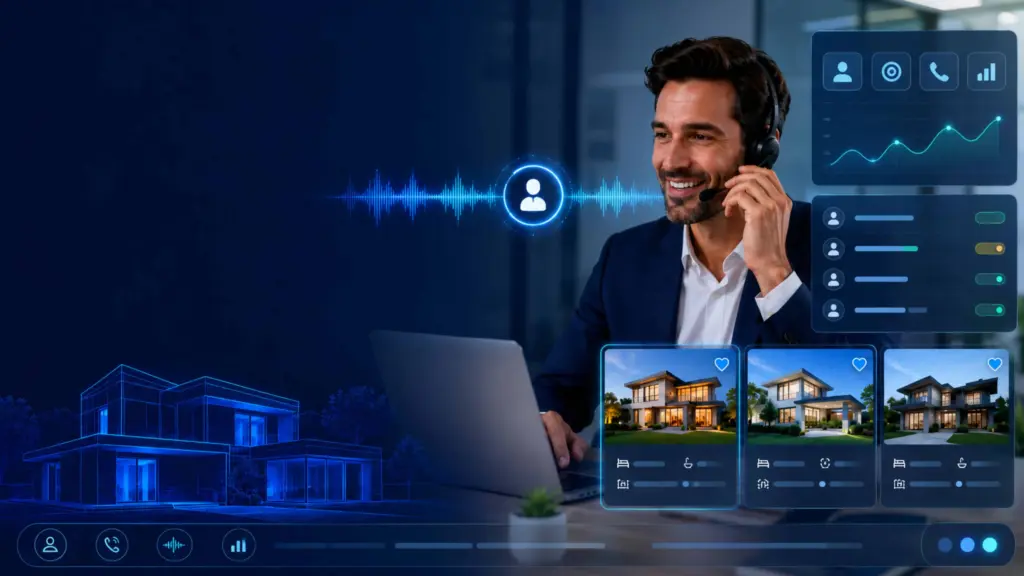
Quick Answer: AI cold calling in real estate, sometimes called an AI calling bot for real estate leads, uses voice agents powered by natural language processing to make outbound prospecting calls, qualify leads, handle objections, and route high-intent prospects to agents automatically. Unlike traditional auto-dialers, these systems hold genuine two-way conversations at scale, 24 hours a day, without agent involvement until a lead is ready to move forward.
The Cold Calling Problem Nobody Talks About Honestly
Cold calling still works in real estate. The data supports it. But the operational reality of running a consistent outbound program is something most teams quietly struggle with.
A dedicated ISA can make 80 to 120 dials in a good day. Maybe 15 to 20 people pick up. Of those, three or four are worth a real conversation. The rest are voicemails, hang-ups, wrong numbers, or politely disinterested contacts who were never going to convert.
That math is exhausting for the people doing it and expensive for the teams paying for it. Turnover in ISA roles runs high because the work is repetitive, emotionally draining, and difficult to keep consistent at volume. When a caller has a bad morning, it shows in the calls. Scripts drift. Energy drops. Conversion rates follow.
This is the operational gap that ai call agents for real estate are built to solve.
What AI Cold Calling Actually Means in a Real Estate Context
The term gets used loosely, so it is worth being precise. AI cold calling in real estate refers specifically to outbound voice automation where an AI agent initiates a call, engages the contact in natural conversation, adapts based on their responses, qualifies their intent, and either books an appointment or routes the contact to a live agent based on preset criteria.
This is meaningfully different from:
- Robocalls or auto-dialers: These play a pre-recorded message and cannot respond to what a contact says
- IVR systems: These route based on keypad input, not real conversation
- SMS automation: Text-based, not voice-based, and does not carry the same rapport-building quality
A well-configured AI voice agent for real estate prospecting can handle a full qualification conversation, including asking about timelines, property preferences, pre-approval status, and motivation to move, without the contact necessarily realizing they are not speaking with a person.
That capability changes the economics of outbound prospecting entirely.
Where AI Cold Calling Fits in the Real Estate Lead Pipeline
Understanding where this technology sits in a lead pipeline is critical to deploying it effectively. Rather than replacing every human touchpoint, AI cold calling works as the engine for the top of the funnel, freeing your agents to focus exclusively on the bottom.
Here is how the workflow typically looks in practice:
Stage 1: List loading and trigger A list of contacts, whether past database leads, sphere of influence, expired listings, FSBOs, or geographic farm targets, is loaded into the system. Calls are triggered on a schedule or based on a behavioral event.
Stage 2: AI-initiated outreach The AI voice agent makes the call, introduces itself (or the agent/brokerage it represents), and moves into a natural conversation. Timing matters here. As covered in our guide on the best time to cold call real estate leads, outreach during the late afternoon window consistently produces higher contact and engagement rates.
Stage 3: Live qualification conversation The AI qualifies the contact using a configured script framework. It listens for buying signals, handles common objections, and adjusts its path based on what the contact says. The script itself adapts in real time, functioning less like a fixed sequence and more like a dynamic conversation tree built on NLP.
Stage 4: Outcome routing Contacts are categorized automatically: hot prospect to be connected live or booked immediately, warm prospect to be followed up within 24 to 48 hours, or not-ready contact to be placed in a long-term nurture sequence. All outcomes sync to your CRM.
Stage 5: Agent engagement Your agent only enters the workflow at Stage 4, with a qualified contact who has already expressed interest. No wasted dials. No unanswered voicemails. No cold rejections.
The Qualification Conversation: What AI Handles vs. What It Does Not
One of the most common misconceptions about AI cold calling is that it handles everything, when in practice it should only handle part of it. The division of labor matters.
What AI voice agents handle well:
- Initial contact and introduction
- Budget and timeline qualification questions
- Property type and area preference gathering
- Pre-approval or financing status questions
- Objection handling for the most common responses (“I’m already working with someone,” “Not ready yet,” “Call me back in a few months”)
- Appointment booking directly into calendar integrations
- Voicemail drops on unanswered calls
- Call logging and CRM sync
What still requires a human agent:
- Relationship building with high-value or referred contacts
- Complex objection scenarios outside standard training
- Negotiation and deal structuring conversations
- Any emotional or sensitive conversation where trust and empathy are primary
The cleaner this division is in your workflow, the better your results. Teams that try to use AI for everything, including conversations that need genuine relationship depth, see declining trust from contacts. Teams that use AI precisely at the top of the funnel and hand off cleanly at the right moment see strong conversion rates throughout the pipeline.
For a deeper look at how the underlying technology handles these conversations, the breakdown in how AI voice calling technology works for real estate covers the NLP mechanics in detail.
Lead Source Matching: Not Every List Needs the Same AI Approach
AI cold calling performs differently depending on the list type. Deploying it without accounting for this is one of the reasons some teams see disappointing initial results.
Expired listings and FSBOs These contacts have already demonstrated intent. They want to transact; the relationship with a specific agent or method just did not work out. AI qualification here should focus on understanding their previous experience and what they need differently. Conversion rates from these lists tend to be higher because intent is pre-established.
Geographic farm lists These are cold by definition. The AI introduction needs to lead with community value, not transaction pressure. A softer qualification approach, focused on gathering interest signals over time, works better than a hard appointment push on first contact.
Past database and sphere reactivation These contacts have a prior relationship with the brokerage. The AI should reference that relationship naturally. Reactivation campaigns on dormant CRM leads are one of the highest-ROI applications of AI calling because the cost per contact is low and the existing trust baseline improves conversion.
Inbound leads requiring fast follow-up Technically not cold calling, but worth noting here. The same AI voice infrastructure used for outbound prospecting is often the most effective way to handle inbound lead response at speed. If someone submits a form at 11 PM, an AI agent calling within 90 seconds is a significant conversion advantage. The full picture of inbound timing is covered in our guide on real estate lead response time and when to call inbound leads.
Compliance, Consent, and Do-Not-Call Protocols
Any serious discussion of AI cold calling has to include compliance. Automated voice outreach operates within a legal framework, and the stakes of getting this wrong are significant.
The core requirements vary by jurisdiction but generally include:
- Contacts on do-not-call registries must be excluded from outbound lists before any campaign runs
- Disclosure requirements in some jurisdictions mandate that AI or automated systems identify themselves as such during a call
- Opt-out mechanisms must be present and functional in every interaction
- Call hours are regulated; most jurisdictions restrict outbound calling to standard business hours
A properly configured AI calling system handles all of this automatically: registry scrubbing before list upload, compliant disclosure language in the opening sequence, real-time opt-out processing, and hour-based call restrictions. The compliance infrastructure is built into the system, not manually managed by your team.
This is one area where AI cold calling is actually more reliable than human callers. Agents under call volume pressure sometimes skip steps. Automated systems do not.
What Qualified Results Look Like at Scale
Teams using AI cold calling at full deployment typically see the following operational changes within 60 to 90 days:
- ISA or agent time on prospecting calls drops by 60 to 70 percent
- The contacts agents speak with personally are pre-qualified, shortening the average qualification call from 8 to 12 minutes to 2 to 4 minutes
- Contact rates across cold lists improve because the system calls at optimal times without fatigue-related inconsistency
- CRM data quality improves significantly because every call outcome is logged automatically with disposition, notes, and follow-up triggers
For commercial-focused teams, the qualification depth AI can reach before routing to a specialist is particularly valuable. The workflow differences between residential and commercial applications are explored in how AI calling helps commercial real estate brokers qualify leads faster.
The broader operational benefits of AI call automation cover the full pipeline impact across both inbound and outbound use cases.
How to Evaluate an AI Cold Calling Platform for Real Estate
Not all platforms are built equally for real estate workflows. When evaluating options, the questions that matter most are:
Conversation quality: Can you listen to real call recordings, not just demos? Does the AI handle mid-conversation pivots naturally or does it break when contacts go off-script?
CRM integration: Does it sync outcomes, dispositions, and notes directly into your existing CRM in real time, or does it require manual exports?
Script configurability: Can you build and test your own conversation flows, or are you locked into generic templates?
Compliance infrastructure: Is do-not-call scrubbing automatic? Is disclosure language built in and auditable?
Reporting depth: Can you see contact rates, conversation length, qualification outcomes, and appointment booking rates by list, by time of day, and by agent?
NOVACRM combines its real estate CRM platform with AVON AI’s voice calling infrastructure to address all of these criteria within a single system. Lead routing, CRM sync, call scheduling, and compliance management operate as connected workflows rather than separate tools requiring integration maintenance.
Frequently Asked Question
AI cold calling uses voice agents powered by natural language processing to make outbound prospecting calls on behalf of real estate agents or brokerages. The AI conducts real qualification conversations, handles objections, and routes interested contacts to human agents for follow-up.
Yes, when properly configured. Compliant platforms automatically scrub do-not-call registries, include required disclosures, respect calling hours, and process opt-outs in real time. Legal requirements vary by jurisdiction, so platform-level compliance infrastructure matters.
Robocalls play a static pre-recorded message and cannot respond to what a contact says. AI cold calling systems hold dynamic two-way conversations, listen to responses, adapt in real time, and qualify leads through a full dialogue.
Expired listings, FSBOs, past database reactivation, and geographic farm lists all produce results when properly configured. Reactivation of dormant CRM contacts typically produces the highest ROI because the cost per contact is low and the prior relationship improves answer and engagement rates.
Most teams see measurable changes in contact rate, qualified appointment volume, and agent time savings within 30 to 60 days of full deployment. Initial configuration and list quality have the biggest impact on early results.
Yes, ‘AI calling bot’ and ‘AI cold calling system’ describe the same technology, voice agents that place outbound calls, qualify leads through conversation, and route qualified contacts to human agents.
The Shift Worth Making
Cold calling has always been a numbers game. The agents and teams who win at it are the ones who can make the most quality contacts consistently over time, without burning out the people doing the work.
AI cold calling shifts who handles the repetitive part of the work, and that shift ripples through agent energy, conversation quality, appointment volume, and conversion rates.
The manual grind was never the point. The qualified conversation at the end of it was. AI just gets you there faster.