


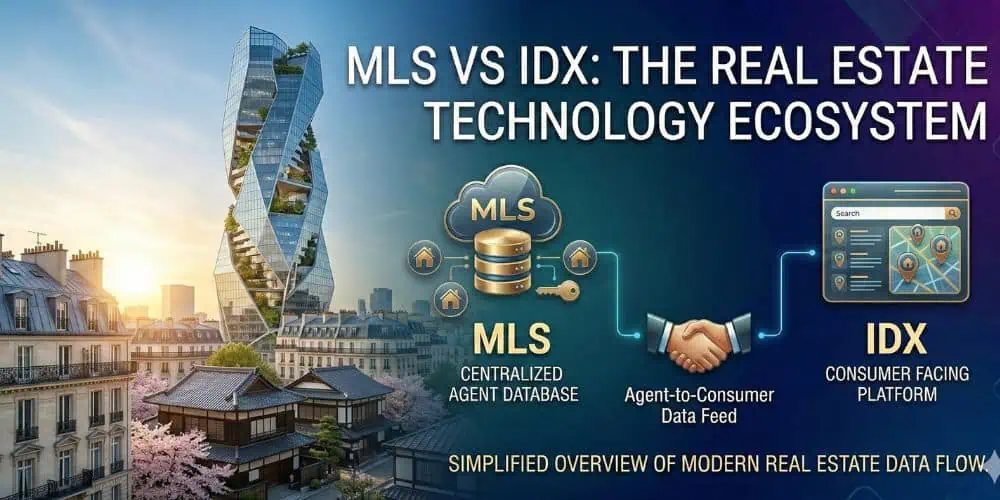
IDX and MLS are related systems, but they serve different purposes. MLS, or Multiple Listing Service, is the private database where licensed real estate professionals create, manage, and share property listings. IDX, or Internet Data Exchange, is the technology that allows approved MLS listing data to appear on public real estate websites.
The simplest way to understand IDX vs MLS is this: MLS is the source of listing data, while IDX is te display system that turns that data into a searchable online property experience.
Agents use MLS to manage listings, review sold data, update statuses, and coordinate transactions. Buyers use IDX-powered websites to search properties, view photos, save listings, request showings, and connect with agents.
For brokerages and teams building real estate agent websites with IDX, understanding the difference between MLS and IDX is essential because each system supports a different part of the real estate workflow.
Why IDX vs MLS Gets Confusing
The confusion usually happens because MLS and IDX work so closely together.
A buyer sees homes on an agent’s website and assumes the website itself owns the listing data. An agent talks about MLS access and IDX integration in the same conversation. A brokerage builds a website, connects a feed, and suddenly both terms appear in vendor proposals, contracts, and tech stack discussions.
But the distinction matters.
If you are trying to manage listings, update prices, check private remarks, or analyze comparable sales, you are dealing with MLS.
If you are trying to show listings on your website, capture buyer leads, create saved searches, or power map-based property search, you are dealing with IDX.
One system supports professional operations. The other supports public property discovery and digital lead generation.
When you understand where each one fits, it becomes much easier to choose the right technology, explain the process to clients, and build a website that actually supports growth.
What Is MLS?
MLS stands for Multiple Listing Service.
It is a private listing database used by licensed real estate professionals to share property information with one another. When an agent represents a seller, the property is entered into the MLS so other participating agents can view it, show it, and bring potential buyers.
The MLS exists because real estate depends on cooperation.
Without a shared listing system, each brokerage would only have visibility into its own inventory. Buyers would see fewer homes. Sellers would receive less exposure. Agents would spend more time searching fragmented sources.
The MLS solves that problem by creating a structured marketplace where property data is standardized, updated, and shared across participating professionals.
What MLS Typically Includes
MLS systems usually contain far more than public listing details.
Depending on local rules, an MLS may include:
- active listings,
- pending or conditional listings,
- sold properties,
- price history,
- days on market,
- property photos,
- broker attribution,
- showing instructions,
- private agent remarks,
- disclosures,
- lot and tax details,
- and comparable sales data.
Some of this information is public-facing. Some remains restricted to licensed professionals because it supports negotiation, compliance, showing coordination, and transaction management.
This is why MLS access is valuable. It gives agents the data needed to advise buyers and sellers with more accuracy than public portals alone.
For a deeper explanation of how MLS systems work, read What Is MLS in Real Estate? Everything You Need to Know About Multiple Listing Service.
What Is IDX?
IDX (Internet Data Exchange) is the technology that lets approved MLS listings appear on public real estate websites — so buyers can search, filter, and save homes directly on an agent’s site instead of a third-party portal.
For the complete breakdown of how IDX websites work, read: What Is an IDX Site?
Ready to Put AI to Work in Your Real Estate Business?
NOVACRM brings your leads, marketing, and client communication into one platform, so nothing falls through the cracks.
Talk to Our Sales TeamIDX vs MLS: The Core Difference
The difference between MLS and IDX comes down to function.
MLS manages the data. IDX displays the data.
| Category | MLS | IDX |
| Main purpose | Listing database and transaction support | Public listing display and property search |
| Primary users | Licensed agents and brokers | Website visitors and buyers |
| Access level | Restricted professional access | Public-facing search experience |
| Data control | Create, edit, update, and manage listings | Read-only listing display |
| Main business role | Operations and market data | Marketing and lead generation |
| Website use | Source of listing data | Powers property search pages |
| CRM relationship | Supports listing and client strategy | Captures buyer intent and lead activity |
This distinction is important because an agent may need both systems, but for completely different reasons.
MLS helps agents operate their business.
IDX helps agents market their business.
How MLS and IDX Work Together
MLS and IDX are not competing technologies. They are connected parts of the same listing ecosystem.
Here is how the workflow usually works:
- A listing agent enters a property into the MLS.
- The MLS validates and publishes the listing.
- Approved listing data becomes available through an IDX feed.
- IDX displays the listing on agent and brokerage websites.
- Buyers search, save, and inquire through the website.
- Lead activity flows into a CRM or follow-up workflow.
The MLS remains the source of truth. IDX reflects approved portions of that data on public websites.
When a listing price changes, a property goes pending, or photos are updated inside the MLS, the IDX feed updates the website based on the provider’s refresh schedule and MLS rules.
This is what allows a website to show current inventory without manual uploads.
What MLS Can Do That IDX Cannot
IDX is useful, but it does not replace MLS access.
MLS allows agents to:
- create new listings,
- edit property details,
- change listing statuses,
- review private remarks,
- access sold data,
- pull comparable sales,
- coordinate showings,
- review historical pricing,
- and prepare market reports.
These are professional functions. They happen inside the MLS because the system is built for licensed real estate operations.
IDX cannot perform these tasks. It cannot change a price, update a status, add private comments, or manage transaction details.
That is why an IDX website is not a substitute for MLS membership.
What IDX Can Do That MLS Cannot
The MLS was not built as a public marketing experience.
IDX fills that gap.
IDX allows websites to provide:
- live property search,
- advanced filters,
- neighborhood browsing,
- interactive map search,
- listing detail pages,
- saved searches,
- property alerts,
- lead capture forms,
- and showing request workflows.
This turns a static real estate website into an active property search platform.
Without IDX, many agent websites are limited to manually added listings, service pages, testimonials, and contact forms.
With IDX, the website becomes a search destination where buyers can spend more time exploring inventory and sharing useful intent signals.
That matters because buyer behavior before the first inquiry is often more valuable than the inquiry itself. A saved search, repeated visit, or favorite listing can reveal price range, location preference, property type, and timeline.
Why IDX Matters for SEO
IDX can support organic visibility, but only when implemented correctly.
Many agents assume that adding MLS listings to a website automatically creates strong SEO results. That is not how search works.
MLS listing descriptions are often duplicated across many websites. If dozens of agent sites show the same property content, search engines need additional reasons to rank one version over another.
That is why strong IDX SEO depends on architecture, not just access.
High-performing IDX websites usually include:
- crawlable listing pages,
- fast mobile templates,
- clean URL structures,
- schema markup,
- neighborhood landing pages,
- internal links between related searches,
- optimized title tags,
- and indexation controls for filtered pages.
Poor IDX setups often create problems such as:
- duplicate listing pages,
- thin content,
- slow page speed,
- JavaScript rendering issues,
- excessive filter URLs,
- crawl inefficiencies,
- and weak local relevance.
A common issue is uncontrolled URL generation. For example, filters for price, bedrooms, property type, and location can create hundreds of similar pages with little unique value. Without canonical handling and index rules, that can dilute crawl efficiency rather than strengthen rankings.
For a deeper implementation guide, read The Complete Guide to IDX Integration.
Why Mobile IDX Experience Matters
IDX performance is also tied closely to mobile experience.
Buyers often search properties from their phones throughout the day. They browse during short breaks, reopen saved searches, compare locations, check photos, and request information when interest becomes serious.
A desktop-first IDX experience creates friction.
A strong mobile IDX experience should include:
- fast listing load times,
- responsive filters,
- simple navigation,
- smooth photo galleries,
- clear map search,
- visible inquiry buttons,
- short lead forms,
- and saved search functionality.
Mobile-first indexing also means search engines evaluate the mobile version of a website as the primary version. If an IDX site is slow or difficult to use on mobile, both rankings and conversions can suffer.
For more on this, read The Future of Property Search: Why Your Clients Need a Mobile-First IDX Experience.
IDX vs MLS in Real-World Workflows
The easiest way to understand the difference between MLS and IDX is to look at daily use.
How Agents Use MLS
An agent may start the day by checking new listings, reviewing status changes, pulling comparable sales, and updating an active listing.
If a seller wants to adjust pricing, the agent updates the MLS.
If a buyer wants to evaluate a neighborhood, the agent pulls sold data and days-on-market trends.
If another agent wants to show a property, they review showing instructions through the MLS.
In this workflow, MLS is the operational system.
How Websites Use IDX
While the agent works inside the MLS, the website uses IDX to serve buyers online.
A visitor can search homes by location, filter by price, view photos, save favorites, and request a showing. The website captures that activity and sends the lead into a follow-up process.
In this workflow, IDX is the marketing and conversion layer.
MLS manages the listing ecosystem. IDX turns part of that ecosystem into a public search experience.
IDX, MLS, and CRM: The Full Digital Workflow
MLS and IDX become far more valuable when connected to CRM workflows.
A modern real estate lead system usually works like this:
- MLS provides accurate listing data.
- IDX displays searchable listings on the website.
- Buyers interact with listings and submit inquiries.
- The CRM captures the lead and behavior.
- Automation sends relevant follow-up.
- Agents prioritize leads based on intent.
This matters because many leads are lost after the initial website interaction.
A buyer may save multiple listings, return several times, or search the same neighborhood repeatedly. If that activity does not flow into a CRM, the agent misses important buying signals.
When IDX activity flows into real estate CRM software, teams can centralize buyer behavior, automate follow-up, and keep online interest connected to active sales conversations.
For a wider look at how these systems fit into a complete real estate technology stack, read Modern Real Estate Sales Tools: Complete Tech Stack Guide.
Common Mistakes When Comparing IDX vs MLS
Mistake 1: Thinking IDX Replaces MLS
IDX displays approved listing data, but it does not replace MLS access. Agents still need MLS to manage listings, statuses, sold data, and professional transaction details.
Mistake 2: Assuming All MLS Data Appears Publicly
IDX only displays permitted fields. Private remarks, showing notes, some seller details, and sensitive transaction data are usually restricted.
Mistake 3: Treating IDX as a Basic Website Widget
A simple search widget is not enough for serious growth. IDX should support SEO, mobile UX, saved searches, lead capture, and CRM workflows.
Mistake 4: Ignoring Technical SEO
Poor IDX implementation can create duplicate content, slow pages, and crawl waste. Strong implementation requires local content structure, schema, internal linking, and page performance.
Mistake 5: Not Connecting Leads to Follow-Up
IDX generates value when buyer behavior turns into action. Without CRM integration, leads can sit in inboxes or dashboards without timely follow-up.
When Do You Need MLS, IDX, or Both?
1. You Need MLS If You:
- list properties,
- represent buyers or sellers,
- update listing statuses,
- access sold data,
- prepare market reports,
- or coordinate transactions.
2. You Need IDX If You:
- want listings on your website,
- want public property search,
- want to capture buyer leads,
- want saved searches and alerts,
- or want stronger online visibility.
3. You Need Both If You:
- are actively growing online,
- want MLS-backed property search,
- want accurate listing data,
- need website lead capture,
- and want buyer activity connected to follow-up workflows.
For most active agents and brokerages, MLS and IDX are not alternatives. They are complementary systems.
Ready to Put AI to Work in Your Real Estate Business?
NOVACRM brings your leads, marketing, and client communication into one platform, so nothing falls through the cracks.
Talk to Our Sales TeamFinal Thoughts
IDX vs MLS is not a question of which one is better.
It is a question of which role each system plays.
MLS is the private professional database where listings are created, updated, managed, and analyzed. It supports cooperation between agents, accurate market data, and transaction coordination.
IDX is the public-facing technology that allows approved MLS listings to appear on websites where buyers can search, browse, save, and inquire.
The strongest real estate businesses understand how both systems work together.
MLS supports operations.
IDX supports visibility and lead generation.
CRM integration connects buyer behavior to follow-up, automation, and conversion.
When these systems are aligned, agents and brokerages gain more control over listing visibility, digital lead generation, client communication, and long-term growth.h